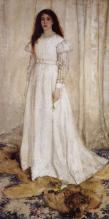
James M Whistler - Symphony in White No 1 - The White Girl (1862) |
| Nationality | American |
| Born | 1834 |
| Died | 1903 |
| Style | realism |
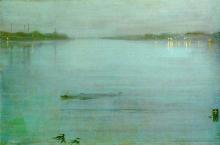
James M Whistler - Nocturne - Blue and Silver (1872) 
James M Whistler - William Merritt Chase (1885) |
James M WhistlerLife and Times James McNeill Whistler was born in Lowell Massachusetts. In 1842, his father, a well respected railroad engineer, gained work in St Petersburg, as a consultant to Czar Nicholas, advising on the newly planned St Petersburg – Moscow route. The whole family made the move to Russia. The young Whistler began his artistic education by attending the Imperial Academy of Fine Arts. In 1849, his father died, and the family moved back to the US. Whistler continued his education first at school, then later by following his father into West Point. Three years after joining the academy, he dropped out, for failing a chemistry exam. A year later, Whistler decided to move to Paris, with the ambition of becoming a professional artist. He studied under Charles-Gabriel Gleyre, a talented Swiss artist. After a period of concentrating on etchings, Whistler turned to oils. His first major painting, At the Piano, was rejected by the Paris Salon. In disgust, Whistler crossed the channel to London, where he stayed until 1892. Through his formative years, Whistler began to think of painting and music as synchronous and parallel arts, so he began naming his works appropriately. His well-know work, Symphony in White No 1 : The White Girl was painted in 1861. This painting, of his model and mistress Jo, has strong Pre-Raphaelite tones. In 1876, one of Whistler’s most generous patrons, Frederick Leyland, commissioned the artist to decorate a dining room. The result was so despised by Leyland that the two fell out, leaving Whistler in financial difficulties.
Further controversy followed in 1877, when the art critic and thinker John Ruskin criticized a series of Whistler's paintings including, Nocturne in Black and Gold: The Falling Rocket by writing in a newspaper article ‘never expected to hear a coxcomb ask two hundred guineas for flinging a pot of paint in the public’s face.’ Whistler sued the critic, eventually winning a farthing damages. The trial, the outcome of which was perhaps not entirely in Whistler’s favor, was brilliant PR, making the artist considerably more famous. Whistler's financial troubles evaporated, as his paintings became commercially successful.
In 1886, Whistler painted Harmony in Red: Lamplight. Portrait of Mrs Beatrice Godwin. The portrait's subject Beatrice lost her husband later the same year. A connection had obviously been made during the sessions sitting for the portrait, as two years later Beatrice and Whistler married. Beatrice was an accomplished painter in her own right – often Whistler turned to her for advice. In 1903 Whistler died in London. |
|||||||
|
Wallpapers Download these high-resolution images to use them as wallpapers for your mobile or desktop screens. |
|||||||
|
|||||||
|
Why in 100 Best? James M Whistler was equally adept at trading witty one-liners with Oscar Wilde, as painting in a considered and masterful style. A true genius. |
|||||||
|
Anything you'd like to say about James McNeill Whistler? Listing contributed by Louise Amend Listing Remove Listing |


Disclaimer 100 Best Everything does not guarantee the accuracy of any listing. Please report offensive listings for removal.